KUALA LUMPUR: MMC Corporation Bhd's (MMC) unit Senai Airport City Sdn Bhd (SACSB) has signed a 60-year land lease agreement with Fuji Oil Asia Pte Ltd (FOAPL) worth RM53.9mil.
MMC said on Monday the 10.02ha industrial land in Senai Airport City (SAC), Iskandar Malaysia, Johor would be used by FOAPL to construct and operate its manufacturing facility.
FOAPL, a subsidiary of Fuji Oil Group headquartered in Osaka, Japan, is a global supplier of intermediate food ingredients particularly in specialty oils and fats, confectionary and bakery, soy protein and related consumer foods products.
MMC said the plant would be FOAPL's largest facility outside Japan, adding SAC was selected for its strategic location adjacent to FOAPL's major client, Hersheys largest chocolate manufacturing facility outside North America.
MMC group managing director Datuk Seri Che Khalib Mohamad Noh said SAC has been dubbed by local and international investors as a southern gateway for high-value industries and a hub for international logistics for industries.
"Investors from Singapore, the US, Japan and Korea recognise the advantages of SAC, and I am confident that FOAPL will gain from these advantages as well, he said.
SACSB is SAC's master developer of a 1,099.94 ha. integrated industrial development, targeting various industrial segments such as Free industrial Zone, Hi-Tech and General Manufacturing, Aerospace Maintenance, Repair and Overhaul and Logistics as well as Mixed Development.
It is currently being developed in phases with 40 per cent of the area completed to date with basic infrastructure for various industrial sectors, said MMC.
It is gazetted as a free zone where investors enjoy various incentives under the Iskandar Region including pioneer status, investment tax allowance and Approved Developer Status, it added.
Saturday, 3 October 2015

Wednesday, 23 September 2015
Investing in buy-to-lease property schemes
MANY of us have seen advertisements or heard about “buy-to-lease” property schemes especially, serviced apartments that are used as hotel accommodation. They sound really good as they allow property investors to gain returns without the hassle of managing the property.
Under such a scheme, owners who purchase a property have to lease the unit back to the property developer or property management company. In exchange, they will get rental returns either based on a guaranteed return model or a profit-sharing scheme, for a set period of time, explains property consultancy PPC International chief executive officer Siva Shanker.
He adds that buy-to-lease properties are not only limited to hotels, serviced apartments and resort homes, as they can be a normal residential property such as a house and condominium, or even student accommodation, office space and industrial property.
In countries such as the UK, investors have numerous choices from hotel rooms, apartments to purpose-built student accommodation where the whole building consists of studio suites that come with kitchenettes.
“However, in Malaysia, the choices are limited as there are not many investment-grade properties available,” says Siva.
According to Siva, buy-to-lease property investments have gained investors’ attention in recent years as most of these schemes promise very attractive rental returns. The average rental return offered is about 5% to 7%, some even up to 12%.
“But keep in mind, like owning a property, owners still have to pay maintenance charges and towards the sinking fund,” he reminds.
One of the recent property projects offering guaranteed rental returns is PTS Properties Sdn Bhd’s luxury condominium hotel The Pines Melaka with leaseback returns of 7.5% per annum for the first nine years and 9% for the following six years. Others include Shama Medini by United Malayan Land Bhd (UMLand), The Ruma by Ireka Corp Bhd and Angsana Teluk Bahang by Banyan Tree Group.
UMLand will launch its buy-to-lease Shama Medini serviced apartments located in Iskandar Malaysia, Johor by the end of this year. Shama Medini offers 196 units of fully furnished apartments for investors. The units with built-ups ranging from 583 to 2,015 sq ft, are available in four layouts — studio, 1-bedroom, 2-bedroom and 3-bedroom. The average selling price is RM1,300 psf.
The owners of Shama Medini will enjoy 6% guaranteed rental returns for the first five years of the leaseback scheme. The next five years will be a revenue-sharing model, in which 45% of the rental revenue will be shared by the owners.
Ireka Corp launched The Ruma hotel and serviced residences in Kuala Lumpur in 2013. The one-acre development, which is located at the Jalan Kia Peng-Changkat Kia Peng junction in Kuala Lumpur, has a gross development value of RM635 million. It offered 253 units of hotel suites for leaseback investment.
The Angsana Teluk Bahang, which is located in Penang, is developed by Senja Aman Development Sdn Bhd and is the first beach resort in Malaysia managed by the Banyan Tree group. It offered 83 units of serviced apartments for leaseback investment. Currently, there are fewer than 10 units available.
Zerin Properties chief executive officer Previndran Singhe says there are three main considerations before deciding on a buy-to-lease investment: yield, benefits (free stay, for example); and discounts on hotel or apartment rentals.
He explains that some operators give time-sharing benefits — certain days for free stays in their property. The stays could be under the same hotel brand, while others may extend the benefits to other brands under their umbrella.
For instance, “at Shama Medini serviced apartments, which will be managed and operated by the ONYX Hospitality Group, investors can enjoy 14 days free stay. They can choose to stay in Shama Medini for seven days, or OZO and Amari hotels, which are under ONYX’s umbrella, for up to seven days,” says Previndran.
Another important point for investors to note is, although you own the property, you can’t occupy it, because once the property is leased back, the owner will not have a say over the property.
“Even if some operators offer you free stays, these are subject to availability, if your unit has been rented out, you may end up staying in another unit,” Previndran explains.
Buy-to-lease schemes are not new to Malaysia, however, there are some things investors need to be aware of.
According to Carey Real Estate Sdn Bhd managing director Nixon Paul, the returns on investment attracted many in the early days, especially for projects located in prime locations catering to the expatriate community.
There were some good quality properties offering buy-to-lease schemes that were worth investing in, but as more investment schemes were introduced, not every one of them honoured their guarantees and many investors became apprehensive about these investments.
“Usually, young and new investors tend to subscribe to these type of property investments. The older and more savvy investors will stay away from guaranteed returns,” says Paul.
For investors who are interested in investing in a property offering guaranteed returns, the first thing to do would be to scrutinise the contracts closely. “Check on who is providing the guarantees and if there are escape clauses,” advises Paul.
Investors also need to check on the financial strength of the developer offering the guarantees. “Further to that, one would need to know if there is legal recourse if the rental payments due are not forthcoming,” he adds.
There are also some companies offering a profit-sharing business model instead of guaranteed rental return. Paul says investors may need to find out whether they possess a licence to do so.
“In Malaysia, profit-sharing on rental income with the developer or an investment company is illegal unless they have a licence from Bank Negara Malaysia to sell these type of investments,” he explains.
More due diligence would be required if the property investment is located overseas. On the checklist would be details regarding income tax, property management fees, commissions, repair and replacement costs, forex gains/losses and several other costs.
“When it comes to investing in a foreign property, it is best to visit the property and conduct a proper due diligence before making your decision,” he explains.
There are other issues related to valuations and property financing which can be a tedious and difficult experience. For instance, a developer overseas may promise to secure financing for the investor, but this may only be done when the property is nearing completion.
“At the time of completion, if the valuation on the property is unable to meet the price that it was purchased for. It means that the investor have to fork out more money for their investment,” he explains.
Hence, there are many things one needs to be aware of before jumping into an investment.
Source: The Edge Property
Under such a scheme, owners who purchase a property have to lease the unit back to the property developer or property management company. In exchange, they will get rental returns either based on a guaranteed return model or a profit-sharing scheme, for a set period of time, explains property consultancy PPC International chief executive officer Siva Shanker.
He adds that buy-to-lease properties are not only limited to hotels, serviced apartments and resort homes, as they can be a normal residential property such as a house and condominium, or even student accommodation, office space and industrial property.
In countries such as the UK, investors have numerous choices from hotel rooms, apartments to purpose-built student accommodation where the whole building consists of studio suites that come with kitchenettes.
“However, in Malaysia, the choices are limited as there are not many investment-grade properties available,” says Siva.
According to Siva, buy-to-lease property investments have gained investors’ attention in recent years as most of these schemes promise very attractive rental returns. The average rental return offered is about 5% to 7%, some even up to 12%.
“But keep in mind, like owning a property, owners still have to pay maintenance charges and towards the sinking fund,” he reminds.
One of the recent property projects offering guaranteed rental returns is PTS Properties Sdn Bhd’s luxury condominium hotel The Pines Melaka with leaseback returns of 7.5% per annum for the first nine years and 9% for the following six years. Others include Shama Medini by United Malayan Land Bhd (UMLand), The Ruma by Ireka Corp Bhd and Angsana Teluk Bahang by Banyan Tree Group.
UMLand will launch its buy-to-lease Shama Medini serviced apartments located in Iskandar Malaysia, Johor by the end of this year. Shama Medini offers 196 units of fully furnished apartments for investors. The units with built-ups ranging from 583 to 2,015 sq ft, are available in four layouts — studio, 1-bedroom, 2-bedroom and 3-bedroom. The average selling price is RM1,300 psf.
The owners of Shama Medini will enjoy 6% guaranteed rental returns for the first five years of the leaseback scheme. The next five years will be a revenue-sharing model, in which 45% of the rental revenue will be shared by the owners.
Ireka Corp launched The Ruma hotel and serviced residences in Kuala Lumpur in 2013. The one-acre development, which is located at the Jalan Kia Peng-Changkat Kia Peng junction in Kuala Lumpur, has a gross development value of RM635 million. It offered 253 units of hotel suites for leaseback investment.
The Angsana Teluk Bahang, which is located in Penang, is developed by Senja Aman Development Sdn Bhd and is the first beach resort in Malaysia managed by the Banyan Tree group. It offered 83 units of serviced apartments for leaseback investment. Currently, there are fewer than 10 units available.
Main considerations
Zerin Properties chief executive officer Previndran Singhe says there are three main considerations before deciding on a buy-to-lease investment: yield, benefits (free stay, for example); and discounts on hotel or apartment rentals.
He explains that some operators give time-sharing benefits — certain days for free stays in their property. The stays could be under the same hotel brand, while others may extend the benefits to other brands under their umbrella.
For instance, “at Shama Medini serviced apartments, which will be managed and operated by the ONYX Hospitality Group, investors can enjoy 14 days free stay. They can choose to stay in Shama Medini for seven days, or OZO and Amari hotels, which are under ONYX’s umbrella, for up to seven days,” says Previndran.
Another important point for investors to note is, although you own the property, you can’t occupy it, because once the property is leased back, the owner will not have a say over the property.
“Even if some operators offer you free stays, these are subject to availability, if your unit has been rented out, you may end up staying in another unit,” Previndran explains.
‘Scrutinise contracts closely’
Buy-to-lease schemes are not new to Malaysia, however, there are some things investors need to be aware of.
According to Carey Real Estate Sdn Bhd managing director Nixon Paul, the returns on investment attracted many in the early days, especially for projects located in prime locations catering to the expatriate community.
There were some good quality properties offering buy-to-lease schemes that were worth investing in, but as more investment schemes were introduced, not every one of them honoured their guarantees and many investors became apprehensive about these investments.
“Usually, young and new investors tend to subscribe to these type of property investments. The older and more savvy investors will stay away from guaranteed returns,” says Paul.
For investors who are interested in investing in a property offering guaranteed returns, the first thing to do would be to scrutinise the contracts closely. “Check on who is providing the guarantees and if there are escape clauses,” advises Paul.
Investors also need to check on the financial strength of the developer offering the guarantees. “Further to that, one would need to know if there is legal recourse if the rental payments due are not forthcoming,” he adds.
There are also some companies offering a profit-sharing business model instead of guaranteed rental return. Paul says investors may need to find out whether they possess a licence to do so.
“In Malaysia, profit-sharing on rental income with the developer or an investment company is illegal unless they have a licence from Bank Negara Malaysia to sell these type of investments,” he explains.
Overseas properties
More due diligence would be required if the property investment is located overseas. On the checklist would be details regarding income tax, property management fees, commissions, repair and replacement costs, forex gains/losses and several other costs.
“When it comes to investing in a foreign property, it is best to visit the property and conduct a proper due diligence before making your decision,” he explains.
There are other issues related to valuations and property financing which can be a tedious and difficult experience. For instance, a developer overseas may promise to secure financing for the investor, but this may only be done when the property is nearing completion.
“At the time of completion, if the valuation on the property is unable to meet the price that it was purchased for. It means that the investor have to fork out more money for their investment,” he explains.
Hence, there are many things one needs to be aware of before jumping into an investment.
Source: The Edge Property
Tuesday, 4 August 2015
Mitsui to offer build-to-suit properties for lease in Nusajaya, Iskandar Malaysia
SINGAPORE – Mitsui & Co Ltd, one of Japan’s largest general trading companies, has entered into a joint-venture (JV) agreement with Singapore’s business space solutions provider Ascendas and Malaysian property developer UEM Sunrise Berhad to offer build-to-suit (BTS) properties for lease in Nusajaya Tech Park in Iskandar Malaysia.
Nusajaya Tech Park Sdn Bhd (NTPSB) is jointly owned by Ascendas and UEM Sunrise. Nusajaya Tech Park will be developed in phases over nine years, according to its website, and is one of the closest industrial sites to the Malaysia-Singapore Second Link.
The JV marks the first Japanese partnership for industrial parks in Iskandar Malaysia, although Mitsui has already developed an extensive network in Japan, especially in sectors such as industrial property development and leasing.
Ascendas, which is a member of Ascendas-Singbridge group, has had over 30 years of experience and assets under management exceeding S$16 billion.
UEM Sunrise, a Malaysian public-listed company, offers services in macro township development, high-rise residential, commercial retail and integrated developments, as well as property management.
Said Reiji Fujita, Mitsui’s general manager of urban development division: “Japanese companies are increasingly seeking investment and expansion opportunities in South East Asia as part of their globalisation strategies. Our collaboration with two very formidable industry leaders in this market, Ascendas and UEM Sunrise, will cement our position as a preferred partner for Japanese companies seeking growth in this part of the world.”
Mitsui and NTPSB will hold equity stakes of 49 per cent and 51 per cent respectively in the JV entity, according to a press release on Tuesday.
Some 10.7 ha of land will be set aside for the development of BTS properties for lease within the 210-ha large Tech Park as part of their agreement, with total development costs estimated at S$167 million over four years.
Said its press release: “the Mitsui-NTPSB joint venture will provide one-stop solution to companies who prefer to operate in customised facilities on long-term leases, without the hassle and capital expenditure associated with the construction process”.
The BTS project intends to oversee and finance the real estate process for customers, including the design, construction and project management, and also offer integrated industrial, commercial spaces, dormitories, amenities and support facilities – all within Nusajaya Tech Park.
“We welcome Mitsui as a new partner in Nusajaya Tech Park,” said William Tay, chief executive officer of Ascendas South East Asia and director of NTPSB. “Through this new joint venture, our customers in Nusajaya Tech Park will not only benefit from solutions that are customised to their business needs, but also enjoy international standards of business space development and operations as a result of the collective strengths of all three partners.
“We are confident that Nusajaya Tech Park will continue to play an instrumental role in catalysing industrial growth and creating an eco-system of high value-added industries in Iskandar Malaysia.”
Source: http://business.asiaone.com/news/mitsui-offer-build-suit-properties-lease-malaysia
Friday, 3 July 2015
Home prices trend sideways on Johor secondary market
PRICES of homes on Johor Baru’s secondary market remained firm in 1Q2015, according to The Edge-KGV International Property Consultants Johor Baru Housing Monitor for the period.

Prices held firm for the second straight quarter in most places sampled by the monitor.
Price growth of certain property types — such as 1-storey terraced houses in Taman Nusa Bistari and Taman Mount Austin, 2-storey terraced houses in Taman Setia Indah, Taman Nusa Bayu and Taman Setia Tropika — remained flat for at least three consecutive quarters.
The values of all high-rise homes in the monitor stayed firm for the past nine months to one-and-a-half years.
While anecdotes from property agents suggest that sales have slowed, data on transactions in 1Q from the National Property Information Centre (Napic) for the period has not been released yet, hence it is still “premature to comment” on the amount of transactions, says Samuel Tan, KGV International Property Consultants (Johor) Sdn Bhd director.
“My take on the same prices prevailing for the second straight quarter could be… the cautious stance taken by buyers. Most of them were, and are, careful not to overprice their purchase,” he tells City & Country.
He says the slower sales were likely a reflection of cautious sentiment among investors. “They are wary of the [current state of the] economy... and its effect on the property market.”
Likewise, the consultancy also found that primary market sales have waned over the quarter on poorer sentiment.
There were few launches in 1Q2015. Of the four landed schemes that were introduced to the market, Sutera 18 — at Bandar Selesa Jaya in Pulai — saw its launch postponed from February this year to next year. The freehold project by Liang Siang Capital Sdn Bhd consists of 18 units of 2-storey semi-detached houses with land areas of 3,520 to 5,162 sq ft, and built-up areas of 3,102 to 3,601 sq ft. Prices range from RM1.01 million to RM1.25 million. KGV International’s research shows there are more than 100 registrants for the project.
According to Tan, notable launches during the quarter were UEM Sunrise Bhd’s Estuari Garden 2-storey superlink homes and Senibong Hills Sdn Bhd’s 3-storey courtyard homes.
Estuari Garden is composed of 83 units of superlink homes with a standard lot size of 24 by 75ft. Their land area is 1,800 sq ft, while built-ups range from 2,708 to 2,989 sq ft. Prices are from RM1.35 million to RM1.8 million, with an 8% rebate and waivers on sale-and-purchase agreement, memorandum of transfer and loan agreement fees, and air-conditioning units for all rooms except for the maid’s room.
“This is one of the few landed residential developments to be launched. Prices reflect the scarcity of such properties,” Tan says.
The freehold Senibong Hills at Senibong Cove consists of 55 units of 3-storey courtyard homes and 3-storey garden terraced homes. The courtyard homes will come in two lot sizes: 35 by 85ft and 35 by 65ft. The units with the larger lot sizes have land areas that range from 2,975 to 5,036 sq ft and built-ups of 4,590 sq ft. They are priced from RM2.53 million to RM3.73 million.
The courtyard homes with the smaller lot sizes have a land area that ranges from 2,275 to 2,845 sq ft, and a built-up of 4,205 sq ft. These are priced from RM2.3 million to RM3.59 million.
Last but not least are the garden terraced homes that have lot sizes of 23 by 106ft and land areas of 2,438 and 5,355 sq ft and built-up of 4,030 sq ft. Prices range from RM2.24 million to RM2.7 million.
The units are currently open for booking. “This scheme shows a new concept within the popular Senibong Cove, which is jointly developed by Walker Group and Iskandar Waterfront Holdings Bhd. Senibong Hills had good response, considering the pricing,” Tan notes.
Issues and notable developments in 1Q15
While the property market in Johor Baru during this period was muted, it was not as uneventful overall in Johor.
Sunway Construction Sdn Bhd was granted a RM170 million contract to design and build the Coastal Highway Southern Link, which will connect parent company Sunway Bhd’s massive Sunway Iskandar township directly to the Second Link.
“This will spur the areas to grow, especially in Iskandar Malaysia-Medini area. Travelling time will be much reduced and Sunway will benefit the most,” Tan says.
Another major player, UEM Sunrise Bhd, launched the 4,500-acre Gerbang Nusajaya. “This area is where Singapore’s Ascendas and UEM Sunrise jointly developed the Nusajaya Hi-Tech Park and the sale rate is reportedly commendable,” he observes.
Meanwhile, Kuala Lumpur Kepong Bhd swapped its 2,000-acre tract in Frasers Estate, Kulai, for a 500-acre parcel in Gerbang Nusajaya.
Reports of an oversupply in high-rise houses led to more developers postponing or reviewing plans for such projects. While this problem had been building up since last year, a report by Maybank Investment on the glut — led by Chinese developers Guangzhou R & F Properties and Country Garden — and price wars in Iskandar have revived concerns among investors.
“Yes, the serviced apartments are over-approved and over-supplied, while the landed residential sector is still within reasonable range,” says Tan.
“Notwithstanding the above, it does not mean serviced apartments will not be in demand. The main criteria are location and selling price. If they are developed in areas where locals stay and the selling prices are within their means, these properties will still be popular.
“Areas such as these include the Tebrau Corridor, Tampoi and Skudai Areas and Permas Jaya area.”
Tan adds: “In terms of pricing, ideally those pegged at RM500 to RM600 psf, with floor area ranging fromfrom 600 to 1,300 sq ft should be able to cater to a wide range of potential local purchasers.”
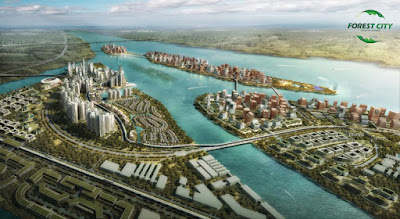
Some projects have also been scaled down or postponed. For instance, Country Garden’s Forest City was scaled down by 30% to 3,425 acres. However, Tan says, it is not the size of the project that matters, but its contents that will determine whether it can draw regional or international attention.
“Personally, I do not think Forest City should be designed merely for the local market. It should be seen as a property where the global rich are attracted to invest in Iskandar. As a result of their investment here, there will also be spin-offs in the other sectors such as services and manufacturing,” he says.
There are plans to build a Customs, Immigration and Quarantine (CIQ) complex on the island, according to reports.
“If the CIQ centre is used as a transport hub for the rapid transit system linking to the bus rapid transit system as well as the proposed light rail transit and other modes of transport like trams within the city, it would impact JB tremendously. The surroundings will be made into a vibrant destination to buying into the ‘Malaysia, Truly Asia’ tagline,” he says.
On Guangzhou R & F’s Princess Cove, Tan says, the project is being developed very slowly. Owing to its position at the entrance into the city, which is the gateway to IM and Malaysia, a negative impression will be created if the project is halted. It will further reinforce the perception that the China-based developers have flooded the market with too many serviced apartments.
“We are at a stage where people are adopting a wait-and-see attitude. This comes on the back of the many changes in the economic climate of the world — the weakening ringgit, the drastic drop in fuel price where Malaysia is a net exporter and the implementation of the Goods and Services Tax causing cost of living to increase. The earlier cooling measures such as curbs on end-financing, abolition of the developer interest-bearing scheme, increase in Real Property Gains Tax, are still affecting the property market,” he says.
According to Tan, places populated by locals continue to be hot spots, with demand staying resilient. Currently, the favourite areas are in the Taman Austin locality, Bukit Indah/Nusajaya, Permas Jaya, Southern link and Skudai/Tampoi areas.
“In future, areas such as Pasir Gudang, Sedenak, Ulu Choh will be attractive to those interested in affordable housing,” he says.
Mixed results in commercial properties
Meanwhile, the Napic Property Market 2014 report showed a jump in transaction volume of commercial properties — to 3,068 from 2,562 units on an annual basis — compared with a huge fall in value to RM4.9 billion from RM10.1 billion.
“This gives the impression that the commercial sub-sector fared badly in 2014. In reality, shopoffices that are one to six storeys tall fared better in 2014 than in the preceding year,” he says, adding that transaction volume rose 30.2% per annum, while values rose 57.5% to RM2.2 billion from RM1.4 billion.
“The drop in the overall transaction value was due to the other property types such as purpose-built office, shopping complex and, particularly, commercial land. The [last category] showed that investors were careful in landbanking, especially for serviced apartments or shopping centres,” he says.
There was an announcement by the state announcing a freeze on any approval of serviced apartments. Even so, those approved previously are allowed to be developed. “Personally I feel a blanket freeze is too drastic. In areas where there is demand, they should be allowed to be developed,” Tan opines.

Source: http://www.theedgeproperty.com/my/content/home-prices-trend-sideways-johor-secondary-market

Prices held firm for the second straight quarter in most places sampled by the monitor.
Price growth of certain property types — such as 1-storey terraced houses in Taman Nusa Bistari and Taman Mount Austin, 2-storey terraced houses in Taman Setia Indah, Taman Nusa Bayu and Taman Setia Tropika — remained flat for at least three consecutive quarters.
The values of all high-rise homes in the monitor stayed firm for the past nine months to one-and-a-half years.
While anecdotes from property agents suggest that sales have slowed, data on transactions in 1Q from the National Property Information Centre (Napic) for the period has not been released yet, hence it is still “premature to comment” on the amount of transactions, says Samuel Tan, KGV International Property Consultants (Johor) Sdn Bhd director.
“My take on the same prices prevailing for the second straight quarter could be… the cautious stance taken by buyers. Most of them were, and are, careful not to overprice their purchase,” he tells City & Country.
He says the slower sales were likely a reflection of cautious sentiment among investors. “They are wary of the [current state of the] economy... and its effect on the property market.”
Likewise, the consultancy also found that primary market sales have waned over the quarter on poorer sentiment.
There were few launches in 1Q2015. Of the four landed schemes that were introduced to the market, Sutera 18 — at Bandar Selesa Jaya in Pulai — saw its launch postponed from February this year to next year. The freehold project by Liang Siang Capital Sdn Bhd consists of 18 units of 2-storey semi-detached houses with land areas of 3,520 to 5,162 sq ft, and built-up areas of 3,102 to 3,601 sq ft. Prices range from RM1.01 million to RM1.25 million. KGV International’s research shows there are more than 100 registrants for the project.
According to Tan, notable launches during the quarter were UEM Sunrise Bhd’s Estuari Garden 2-storey superlink homes and Senibong Hills Sdn Bhd’s 3-storey courtyard homes.
Estuari Garden is composed of 83 units of superlink homes with a standard lot size of 24 by 75ft. Their land area is 1,800 sq ft, while built-ups range from 2,708 to 2,989 sq ft. Prices are from RM1.35 million to RM1.8 million, with an 8% rebate and waivers on sale-and-purchase agreement, memorandum of transfer and loan agreement fees, and air-conditioning units for all rooms except for the maid’s room.
“This is one of the few landed residential developments to be launched. Prices reflect the scarcity of such properties,” Tan says.
The freehold Senibong Hills at Senibong Cove consists of 55 units of 3-storey courtyard homes and 3-storey garden terraced homes. The courtyard homes will come in two lot sizes: 35 by 85ft and 35 by 65ft. The units with the larger lot sizes have land areas that range from 2,975 to 5,036 sq ft and built-ups of 4,590 sq ft. They are priced from RM2.53 million to RM3.73 million.
The courtyard homes with the smaller lot sizes have a land area that ranges from 2,275 to 2,845 sq ft, and a built-up of 4,205 sq ft. These are priced from RM2.3 million to RM3.59 million.
Last but not least are the garden terraced homes that have lot sizes of 23 by 106ft and land areas of 2,438 and 5,355 sq ft and built-up of 4,030 sq ft. Prices range from RM2.24 million to RM2.7 million.
The units are currently open for booking. “This scheme shows a new concept within the popular Senibong Cove, which is jointly developed by Walker Group and Iskandar Waterfront Holdings Bhd. Senibong Hills had good response, considering the pricing,” Tan notes.
Issues and notable developments in 1Q15
While the property market in Johor Baru during this period was muted, it was not as uneventful overall in Johor.
Sunway Construction Sdn Bhd was granted a RM170 million contract to design and build the Coastal Highway Southern Link, which will connect parent company Sunway Bhd’s massive Sunway Iskandar township directly to the Second Link.
“This will spur the areas to grow, especially in Iskandar Malaysia-Medini area. Travelling time will be much reduced and Sunway will benefit the most,” Tan says.
Another major player, UEM Sunrise Bhd, launched the 4,500-acre Gerbang Nusajaya. “This area is where Singapore’s Ascendas and UEM Sunrise jointly developed the Nusajaya Hi-Tech Park and the sale rate is reportedly commendable,” he observes.
Meanwhile, Kuala Lumpur Kepong Bhd swapped its 2,000-acre tract in Frasers Estate, Kulai, for a 500-acre parcel in Gerbang Nusajaya.
Reports of an oversupply in high-rise houses led to more developers postponing or reviewing plans for such projects. While this problem had been building up since last year, a report by Maybank Investment on the glut — led by Chinese developers Guangzhou R & F Properties and Country Garden — and price wars in Iskandar have revived concerns among investors.
“Yes, the serviced apartments are over-approved and over-supplied, while the landed residential sector is still within reasonable range,” says Tan.
“Notwithstanding the above, it does not mean serviced apartments will not be in demand. The main criteria are location and selling price. If they are developed in areas where locals stay and the selling prices are within their means, these properties will still be popular.
“Areas such as these include the Tebrau Corridor, Tampoi and Skudai Areas and Permas Jaya area.”
Tan adds: “In terms of pricing, ideally those pegged at RM500 to RM600 psf, with floor area ranging fromfrom 600 to 1,300 sq ft should be able to cater to a wide range of potential local purchasers.”

Some projects have also been scaled down or postponed. For instance, Country Garden’s Forest City was scaled down by 30% to 3,425 acres. However, Tan says, it is not the size of the project that matters, but its contents that will determine whether it can draw regional or international attention.
“Personally, I do not think Forest City should be designed merely for the local market. It should be seen as a property where the global rich are attracted to invest in Iskandar. As a result of their investment here, there will also be spin-offs in the other sectors such as services and manufacturing,” he says.
There are plans to build a Customs, Immigration and Quarantine (CIQ) complex on the island, according to reports.
“If the CIQ centre is used as a transport hub for the rapid transit system linking to the bus rapid transit system as well as the proposed light rail transit and other modes of transport like trams within the city, it would impact JB tremendously. The surroundings will be made into a vibrant destination to buying into the ‘Malaysia, Truly Asia’ tagline,” he says.
On Guangzhou R & F’s Princess Cove, Tan says, the project is being developed very slowly. Owing to its position at the entrance into the city, which is the gateway to IM and Malaysia, a negative impression will be created if the project is halted. It will further reinforce the perception that the China-based developers have flooded the market with too many serviced apartments.
“We are at a stage where people are adopting a wait-and-see attitude. This comes on the back of the many changes in the economic climate of the world — the weakening ringgit, the drastic drop in fuel price where Malaysia is a net exporter and the implementation of the Goods and Services Tax causing cost of living to increase. The earlier cooling measures such as curbs on end-financing, abolition of the developer interest-bearing scheme, increase in Real Property Gains Tax, are still affecting the property market,” he says.
According to Tan, places populated by locals continue to be hot spots, with demand staying resilient. Currently, the favourite areas are in the Taman Austin locality, Bukit Indah/Nusajaya, Permas Jaya, Southern link and Skudai/Tampoi areas.
“In future, areas such as Pasir Gudang, Sedenak, Ulu Choh will be attractive to those interested in affordable housing,” he says.
Mixed results in commercial properties
Meanwhile, the Napic Property Market 2014 report showed a jump in transaction volume of commercial properties — to 3,068 from 2,562 units on an annual basis — compared with a huge fall in value to RM4.9 billion from RM10.1 billion.
“This gives the impression that the commercial sub-sector fared badly in 2014. In reality, shopoffices that are one to six storeys tall fared better in 2014 than in the preceding year,” he says, adding that transaction volume rose 30.2% per annum, while values rose 57.5% to RM2.2 billion from RM1.4 billion.
“The drop in the overall transaction value was due to the other property types such as purpose-built office, shopping complex and, particularly, commercial land. The [last category] showed that investors were careful in landbanking, especially for serviced apartments or shopping centres,” he says.
There was an announcement by the state announcing a freeze on any approval of serviced apartments. Even so, those approved previously are allowed to be developed. “Personally I feel a blanket freeze is too drastic. In areas where there is demand, they should be allowed to be developed,” Tan opines.
Wednesday, 10 June 2015
Iskandar Malaysia Second Comprehensive Development Plan CDP
NUSAJAYA: The second Iskandar Malaysia Comprehensive Development Plan (CDP) is expected to be launched at the end of the second quarter or early third quarter of this year.
Iskandar Regional Development Authority IRDA chief executive officer, Datuk Ismail Ibrahim, said the second CDP was a review of the first which was launched in 2006.
He said the new CDP has been submitted to the authorities including Prime Minister Datuk Seri Najib Tun Razak and Johor Mentri Besar Datuk Seri Mohamed Khaled Nordin.
On a separate note, Datuk Ismail Ibrahim said that in the first quarter of this year, Iskandar Malaysia secured RM7.8bil in new investments, of which 64% were domestic and the rest foreign. This brings the total realised investments to RM166 billion since the growth corridor was launched in 2006.
On the incentives given to Singapore's small and medium enterprises investing in Iskandar Malaysia, he said they would depend on the types of investments.
"Also the investments, be they in the services or manufacturing sectors, must meet our terms.
"They have to be environment-friendly, capital-intensive and use less labour," he said.
Iskandar Malaysia remains on track to attract between RM25bil and RM30 bil investments this year.
This is despite the scrapping of the RM600 million China Mall trade centre project by its main developer UEM Sunrise Bhd.
The main focus over the next few years will be in the creative and logistics sectors, said Iskandar Regional Development Authority CEO Datuk Ismail Ibrahim.
He was speaking at a media briefing "Elevating Cross-border Opportunities in ASEAN and Beyond" by Standard Chartered Bank, here today. The authorities have however cautioned property developers into the "feasibility of things" by ensuring the supply matches the demand in the long run.
Iskandar Regional Development Authority IRDA chief executive officer, Datuk Ismail Ibrahim, said the second CDP was a review of the first which was launched in 2006.
He said the new CDP has been submitted to the authorities including Prime Minister Datuk Seri Najib Tun Razak and Johor Mentri Besar Datuk Seri Mohamed Khaled Nordin.
On a separate note, Datuk Ismail Ibrahim said that in the first quarter of this year, Iskandar Malaysia secured RM7.8bil in new investments, of which 64% were domestic and the rest foreign. This brings the total realised investments to RM166 billion since the growth corridor was launched in 2006.
On the incentives given to Singapore's small and medium enterprises investing in Iskandar Malaysia, he said they would depend on the types of investments.
"Also the investments, be they in the services or manufacturing sectors, must meet our terms.
"They have to be environment-friendly, capital-intensive and use less labour," he said.
Iskandar Malaysia remains on track to attract between RM25bil and RM30 bil investments this year.
This is despite the scrapping of the RM600 million China Mall trade centre project by its main developer UEM Sunrise Bhd.
The main focus over the next few years will be in the creative and logistics sectors, said Iskandar Regional Development Authority CEO Datuk Ismail Ibrahim.
He was speaking at a media briefing "Elevating Cross-border Opportunities in ASEAN and Beyond" by Standard Chartered Bank, here today. The authorities have however cautioned property developers into the "feasibility of things" by ensuring the supply matches the demand in the long run.
Thursday, 28 May 2015
Iskandar Malaysia Asian Trade Centre project scrapped
The principal developer of Iskandar Malaysia, UEM Sunrise Bhd, has ceased its plan to build Asian Trade Centre project in Nusajaya, Iskandar Malaysia.
Singapore's The Straits Times reported today that no reason was given for the decision to halt plans to build the huge Asian Trade Centre (ATC) in Iskandar Malaysia, Johor.
The newspaper noted that this would likely intensify concerns that the fast-growing region is hitting some "speed bumps".
The move has stunned property experts, especially since UEM Sunrise managing director and chief executive Anwar Syahrin Abdul Ajib was quoted in a New Straits Times report last December as saying the company was "in the midst of getting approvals from the relevant authorities" for the Iskandar project.
A property consultant noted the first phase of the centre's development, the China Mall, was supposed to be a catalyst - a mall "even larger than Pavilion in Kuala Lumpur", and meant to attract foreign investors.
'Further worries in the property market'
"Cancelling it is not good for business. Others may have made plans based on the announcement," the consultant said.
Others in the industry said the decision to drop such a large facility would create further worry in the Iskandar property market, which is already weakened by oversupply concerns in the residential sector.
ATC-China Mall was to be akin to the Dragon Mart in Dubai that Chinamall Holdings opened in 2004.
Anwar Syahrin said last December that UEM Sunrise was building the trade centre because it believed Malaysian products were not being marketed properly.
"We want international and local manufacturers to showcase their products and do trade shows at the ATC. We are tying up with Chinamall Holdings Pte Ltd from China,” he was quoted as saying in the New Straits Times report.
The 1.4 million sq-ft mall, worth more than RM600 million, was supposed to house more than 3,000 merchants offering products such as textiles, gifts, souvenirs, electrical and household appliances, furniture, toys and jewellery.
The ATC is in the Nusajaya area, about a five-minute drive from the Johor Bahru checkpoint at the Second Link with Singapore.
It was to have been part of the 1,840ha Gerbang Nusajaya, the site of the second development phase of Nusajaya city. The area includes Puteri Harbour and the upcoming Nusajaya Tech Park and Motorsports City.
UEM Sunrise had signed a memorandum of understanding with Chinamall Holdings in late 2012 to develop the China Mall.
According to its website, Chinamall Holdings, which is incorporated in Singapore, is a building materials trader and constructs and operates specialised wholesale markets.
The deal was for UEM Sunrise to own the mall, with Chinamall Holdings managing and marketing it on a long-term lease.
Source: http://www.malaysiakini.com/news/299656
Singapore's The Straits Times reported today that no reason was given for the decision to halt plans to build the huge Asian Trade Centre (ATC) in Iskandar Malaysia, Johor.
The newspaper noted that this would likely intensify concerns that the fast-growing region is hitting some "speed bumps".
The move has stunned property experts, especially since UEM Sunrise managing director and chief executive Anwar Syahrin Abdul Ajib was quoted in a New Straits Times report last December as saying the company was "in the midst of getting approvals from the relevant authorities" for the Iskandar project.
A property consultant noted the first phase of the centre's development, the China Mall, was supposed to be a catalyst - a mall "even larger than Pavilion in Kuala Lumpur", and meant to attract foreign investors.
'Further worries in the property market'
"Cancelling it is not good for business. Others may have made plans based on the announcement," the consultant said.
Others in the industry said the decision to drop such a large facility would create further worry in the Iskandar property market, which is already weakened by oversupply concerns in the residential sector.
ATC-China Mall was to be akin to the Dragon Mart in Dubai that Chinamall Holdings opened in 2004.
Anwar Syahrin said last December that UEM Sunrise was building the trade centre because it believed Malaysian products were not being marketed properly.
"We want international and local manufacturers to showcase their products and do trade shows at the ATC. We are tying up with Chinamall Holdings Pte Ltd from China,” he was quoted as saying in the New Straits Times report.
The 1.4 million sq-ft mall, worth more than RM600 million, was supposed to house more than 3,000 merchants offering products such as textiles, gifts, souvenirs, electrical and household appliances, furniture, toys and jewellery.
The ATC is in the Nusajaya area, about a five-minute drive from the Johor Bahru checkpoint at the Second Link with Singapore.
It was to have been part of the 1,840ha Gerbang Nusajaya, the site of the second development phase of Nusajaya city. The area includes Puteri Harbour and the upcoming Nusajaya Tech Park and Motorsports City.
UEM Sunrise had signed a memorandum of understanding with Chinamall Holdings in late 2012 to develop the China Mall.
According to its website, Chinamall Holdings, which is incorporated in Singapore, is a building materials trader and constructs and operates specialised wholesale markets.
The deal was for UEM Sunrise to own the mall, with Chinamall Holdings managing and marketing it on a long-term lease.
Source: http://www.malaysiakini.com/news/299656
Saturday, 16 May 2015
RM2.5b Venice-style project in Sungai Danga, Johor Bahru
Sungai Danga, one of the most polluted rivers in the Johor state is poised to undergo a facelift with the first development phase of the River City@Danga project involves the cleaning up, beautification and transformation of Sungai Danga valued at RM2.5 billion.
The project being developed by Riverside Terra Sdn Bhd, a wholly owned subsidiary of Iskandar Waterfront Sdn Bhd, focuses on clean-up and beautification efforts to turn the river into a 'Venice of the East' and make it a renowned riverine tourism destination.
Developed on a 21-ha site, it will transform the area with several attractions, among others, hotels, apartments and office suites that are equipped with open berthing facilities, retail shops and a 6km boardwalk on both banks of the river.
Iskandar Waterfront Holdings Sdn Bhd group executive director Lim Chen Herng said other development being planned was the construction of the two man made islands that have thematic features to reflect the ethnic and cultural diversity found in the state.
"Under the project, the river will be turned into a new tourist destination. It is no ordinary project but one that will become a new landmark," Menteri Besar Datuk Seri Mohamed Khaled Nordin said in the launch and ground breaking ceremony for the project, here yesterday.
"This is the first such island in the country where the Malays, Chinese, Indians and others could display their unique cultural heritage, customs, dances, traditions and art works for the sake of tourism," Mohamed Khaled said.
Meanwhile Mohamed Khaled in his speech said the project would become an important catalyst to the tourism sector in the Iskandar Malaysia Flagship A.
"Directly or indirectly, it offers significant benefits to the economy of Johor due to the diversity of tourism product components besides enabling local communities to raise their living standard," he said.
In a move to address fears of foreigners snapping up all available property, the state will designate international zones or housing development projects within Iskandar Malaysia.
Mentri Besar Datuk Mohamed Khaled Nordin said the state government had identified 2 areas for the international zones designated for foreigners and was finalising the details.
The plans would be publish to the public, either in July or August, and the public and developers would be invited to give their feedback.
“There are 2 areas that we want to present. The first part will be on the growth of the international area and the other related to our policies to control oversupply of service apartments,” he told reporters after launching the groundbreaking ceremony of The River City@Danga project by Riverside Terra Sdn Bhd, a subsidiary of Iskandar Waterfront Sdn Bhd.
“We have nothing to hide, and it will be a win-win situation for both sides,” he said, adding that the international zone would help increase the competitiveness of the Johor property market and protect local buyers.
The project being developed by Riverside Terra Sdn Bhd, a wholly owned subsidiary of Iskandar Waterfront Sdn Bhd, focuses on clean-up and beautification efforts to turn the river into a 'Venice of the East' and make it a renowned riverine tourism destination.
Developed on a 21-ha site, it will transform the area with several attractions, among others, hotels, apartments and office suites that are equipped with open berthing facilities, retail shops and a 6km boardwalk on both banks of the river.
Iskandar Waterfront Holdings Sdn Bhd group executive director Lim Chen Herng said other development being planned was the construction of the two man made islands that have thematic features to reflect the ethnic and cultural diversity found in the state.
"Under the project, the river will be turned into a new tourist destination. It is no ordinary project but one that will become a new landmark," Menteri Besar Datuk Seri Mohamed Khaled Nordin said in the launch and ground breaking ceremony for the project, here yesterday.
"This is the first such island in the country where the Malays, Chinese, Indians and others could display their unique cultural heritage, customs, dances, traditions and art works for the sake of tourism," Mohamed Khaled said.
Meanwhile Mohamed Khaled in his speech said the project would become an important catalyst to the tourism sector in the Iskandar Malaysia Flagship A.
"Directly or indirectly, it offers significant benefits to the economy of Johor due to the diversity of tourism product components besides enabling local communities to raise their living standard," he said.
In a move to address fears of foreigners snapping up all available property, the state will designate international zones or housing development projects within Iskandar Malaysia.
Mentri Besar Datuk Mohamed Khaled Nordin said the state government had identified 2 areas for the international zones designated for foreigners and was finalising the details.
The plans would be publish to the public, either in July or August, and the public and developers would be invited to give their feedback.
“There are 2 areas that we want to present. The first part will be on the growth of the international area and the other related to our policies to control oversupply of service apartments,” he told reporters after launching the groundbreaking ceremony of The River City@Danga project by Riverside Terra Sdn Bhd, a subsidiary of Iskandar Waterfront Sdn Bhd.
“We have nothing to hide, and it will be a win-win situation for both sides,” he said, adding that the international zone would help increase the competitiveness of the Johor property market and protect local buyers.
Subscribe to:
Posts (Atom)